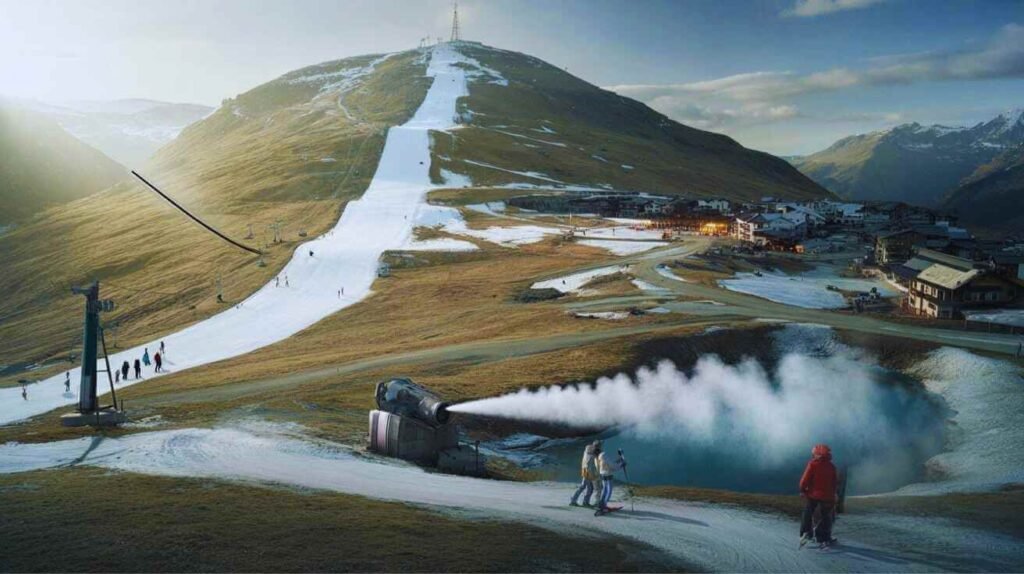
As climate change reshapes winter patterns across major mountain regions, ski resorts are facing a difficult strategic decision: should they continue investing heavily in artificial snowmaking systems, or is the long-term return becoming too uncertain? Warmer winters, shorter snow seasons, and increasingly erratic snowfall are forcing operators to rethink business models built on predictable cold-weather conditions.
Industry experts say the debate is no longer theoretical. Resorts across Europe and North America are already allocating millions of dollars annually to expand snowmaking capacity in an effort to stabilize operations.
Snowmaking as a Climate Adaptation Strategy
Artificial snow production has become one of the primary tools resorts use to offset declining natural snowfall. Modern systems allow ski areas to cover key slopes, maintain holiday-season reliability, and extend opening windows even during marginal weather.
Resort operators argue that snowmaking is essential for revenue protection. Without it, early-season closures and midwinter melt events could severely impact bookings, staffing, and regional tourism economies.
Rising Costs and Energy Concerns
However, snowmaking is energy-intensive and water-dependent. Climate analysts warn that as temperatures rise, resorts must run systems longer and under narrower weather conditions, increasing operational costs.
Electricity consumption, infrastructure upgrades, and water sourcing are becoming major financial pressures. In some regions, water availability itself is emerging as a constraint, particularly where drought cycles are intensifying.
Environmental Trade-Offs
Environmental groups question whether large-scale snowmaking aligns with broader climate sustainability goals. Critics point to greenhouse gas emissions from energy use, ecosystem disruption from water extraction, and landscape alteration from expanded snow infrastructure.
Some climate scientists argue that adaptation strategies should prioritize diversification rather than doubling down on resource-heavy technologies.
Economic Reality for Mountain Communities
For many alpine towns, ski tourism remains the backbone of local economies. Business owners, workers, and municipal leaders often support snowmaking investments, viewing them as necessary for job preservation and economic stability.
A poor winter season can ripple through hospitality, retail, transport, and property markets, amplifying financial risks for entire regions.
Shifting Toward Diversification
In response, a growing number of resorts are pursuing four-season tourism strategies. Investments in hiking, mountain biking, wellness tourism, and events aim to reduce reliance on winter snowfall.
Analysts say diversification may offer stronger long-term resilience, particularly for lower-elevation resorts most vulnerable to warming trends.
The Strategic Dilemma
The core challenge lies in balancing short-term survival with long-term viability. Snowmaking can stabilize revenue today, but escalating costs and climate uncertainty raise questions about sustainability over the coming decades.
Financial experts note that snowmaking investments require long amortization periods, making future climate projections a critical factor in capital planning.
Outlook
There is no universal answer for the industry. High-altitude resorts with colder microclimates may justify continued expansion, while lower-elevation operators face increasingly difficult economics.
What is clear, experts say, is that climate change is transforming winter sports from a seasonal certainty into a high-risk business environment. For ski resorts worldwide, the decision to invest in snowmaking is no longer just an operational choice — it is a defining test of long-term strategy in a warming world.



![[Analysis] FDI Frigate The Combat-Ready Solution That Could Reshape the Swedish Navy](https://pioneergasltd.co.uk/wp-content/uploads/2026/02/Analysis-FDI-Frigate-The-Combat-Ready-Solution-That-Could-Reshape-the-Swedish-Navy-1024x574.jpg)